


The hidden fastener for decking boards ensures very simple and quick installation for decks made of Douglas fir. Fastener is suitable for 19-32mm material thickness.
The fasteners are installed underneath the decking board, so that the fastening screws are not visible on the deck surface. The fastener also adds an air gap between the deck frame and the surface boards, which allows the structure to dry faster and extend its service life.
Fasteners allow the decking boards to expand and shrink due to moisture changes.
The fasteners are supplied with installation screws, installation spacer and installation instructions. The fasteners are available in packages of 100 and 300 pieces. Separate start or end pieces are not required.
Fastener is made of glass fibre reinforced polyamide and supplied with stanless steel screws.
A deck that gets more beautiful every year
Douglas fir stands up to the Finnish climate without any surface treatment. Left untreated, the deck weathers to a silvery gray in about 2–3 years of rain and sun, and it never needs oiling or painting.
Dense and naturally rot-resistant
Douglas fir is a dense, naturally rot-resistant wood species. The light sapwood and reddish heartwood give a new deck a lively look, and the tones even out as the wood weathers.
Built to last
A well-designed, carefully installed deck lasts for decades. We only promise what we can deliver, which is why the installation guide includes every measurement, from the frame to the gaps and screws.
Made-to-Order Product
A made-to-order product is a good choice for larger projects that require a specific profile in a specific wood species. It is a suitable option when procurement can be planned well in advance of the actual need.
Made-to-order products are manufactured to the customer's requirements, so every order is unique. Delivery time and final price depend on several factors, which are always considered separately when preparing a quotation.
You will receive an exact quotation and delivery estimate once the order details have been confirmed. The more detailed the information on the product, quantity and desired specification we receive at the outset, the faster we can process your order.
Please note, however, that the precision of material and profile requirements affects the manufacturability of the product. The more detailed the requirements, the more limited the production options may be. Feasibility is also assessed based on the availability of raw material.
Delivery Time
Delivery time is particularly affected by the availability of raw material. Raw material availability varies by wood species and grade. Larger order volumes also require more preparation and production time so that the order can be scheduled into production. Multi-stage processing of the product, such as planing, end-matching and surface treatment, affects the delivery time and requires a longer production time.
The estimated delivery time indicates when the goods will be ready for shipment or collection from our warehouse. We confirm an individual delivery time for each order. Below are examples of typical delivery times for different cases.
Products with a delivery time from 2–4 weeks
This delivery time is possible when the raw material is available and a production run for a corresponding product is scheduled soon, allowing the order to be combined with that run. Otherwise, the delivery time is at least 4 weeks. The estimate does not take production queue congestion into account and is intended as a guideline only.
- Surface treatment
- Standard stock profile
- Minor modifications to a standard stock profile, e.g. width or thickness
Standard stock profile = A product identical in dimensions and shape, for example in another wood species
Products with a delivery time assessed case by case
- Standard stock profile with no raw material in stock
- Special profile with no raw material in stock
Both of the above cases are only possible for large projects, with a delivery time of at least 2 months
Restrictions
The order quantity must be at least as stated below.
- 500m for a stock product to be surface treated
- 1000m for a standard stock profile
- 2000m for a standard stock profile with minor modifications
- One bundle of sawn timber (approx. 4m³) if the order is not a standard stock profile
- Multiples of sawn timber bundles (approx. 4m³) (1,2,3,..) when the raw material is not in stock.
Thickness
- Product thickness can range between 12-45mm.
Width
- Product width can range between 40-200mm.
Length
- Timber lengths range between 1.8-6.0m. We aim to meet length requests wherever possible, but unfortunately this is not always possible.
Waste Allowance
To avoid a costly supplementary order, include a sufficient waste allowance in your order. The costs of a small supplementary order can be at least 5x those of the original. Any supplementary order takes at least as long to produce as the original order, and its price is quoted as a separate delivery.
Ordered and Delivered Quantity
A tolerance of ±10 percent is permitted in the delivered quantity of timber compared with the quantity stated in the order confirmation. This means that the delivered quantity may be up to 10 percent less or more than the quantity ordered. As timber is a natural material, its properties are subject to natural variation. For this reason, the amount of waste generated in production cannot be predicted entirely accurately. The final quantity therefore cannot be predicted in advance; it is determined during manufacturing and rarely matches the ordered quantity exactly.
Product information
| Tuotenimi | TERASSIN PIILOKIINNIKE DILA C 100 KPL/PKT |
| Tuotenumero | 017005000 |
| Toimitusaika | noin 3-4 viikkoa, tarkista myynnistä |
| Saatavuus | Ole yhteydessä myyntiin |
| CN-koodi | Plastic fixings - CN 3926 9097 |
Product measurements
| Vahvuus (mm) | 0 |
| Leveys (mm) | 0 |
| Paino (kg/myyntiyksikkö) | 1,262 |
| Pakkauskoko (kpl/pkt) | 100 |
Product features
Sustainability
Minimum order size
Please note that we deliver our products in bundles. Bundle size is indicated together with stock information on top right corner.
 Planning your deck
Douglas fir and larch are naturally rot-resistant and dense wood species. They are well suited to decks, piers, steps and other outdoor structures without surface treatment. Left untreated, the wood turns a beautiful silvery gray over time.
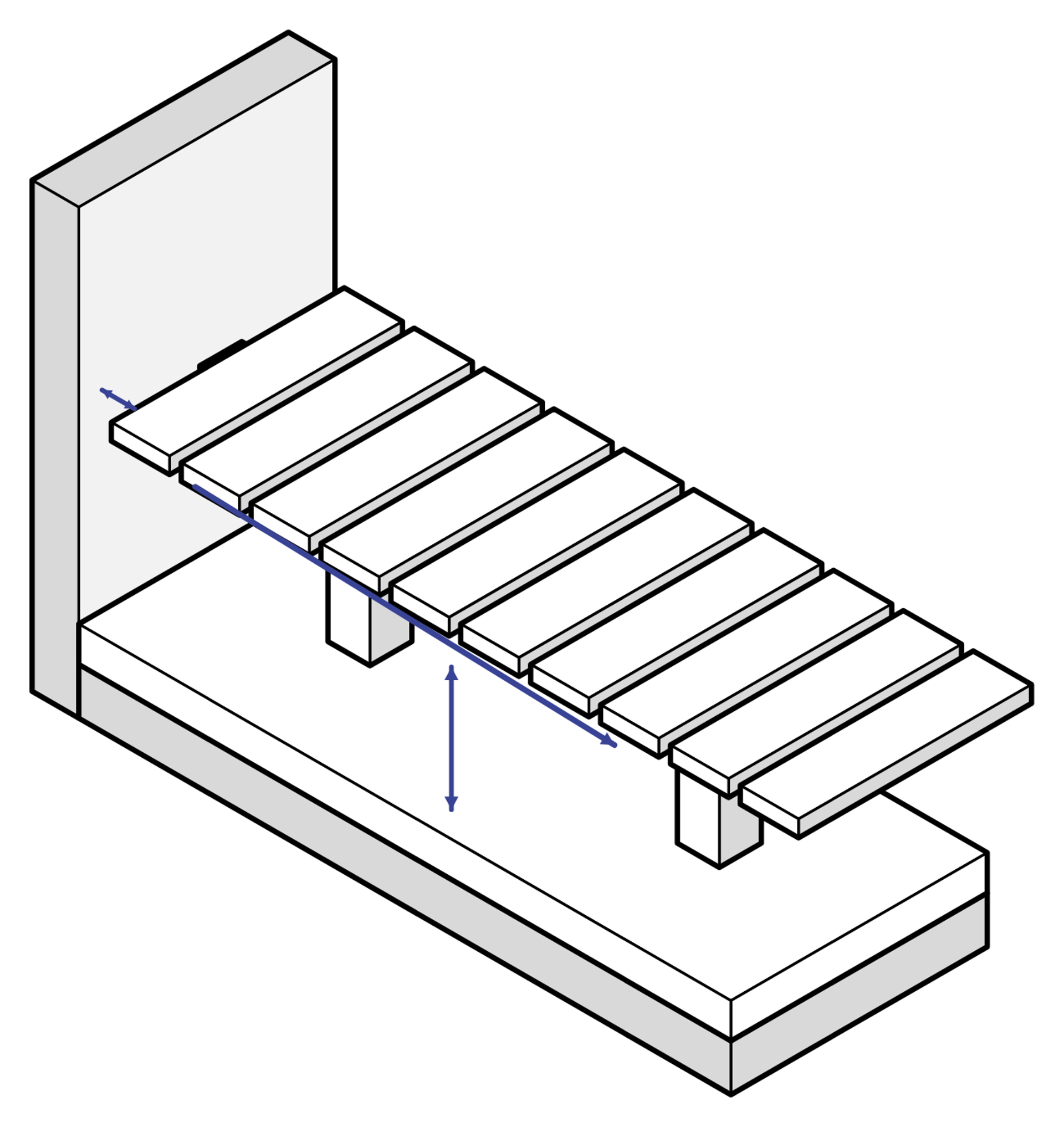
Plan before you build
- Permits. Check your local building regulations. Your deck may require a permit.
- Board direction. Where possible, lay the boards across the main walking direction. This reduces the risk of slipping. The direction of the boards and the position of any joints affect how the frame is built.
- Water and ventilation. Slope the deck 1–2% away from the building and leave a ventilation space of at least 100 mm under the frame. Leave a gap of at least 20 mm between the deck and the wall.
- Frame. Use wood suitable for use class 3.2 in the frame. Joist spacing depends on the board thickness: 400–600 mm for 28 mm boards and 600–800 mm for 45 mm boards.
- Color. If you want to slow down graying, you can oil the deck. Without repeated treatment, the natural graying of the wood can't be prevented.
- Other outdoor structures. Our range also includes posts for railings, for example, and slats for privacy screens and decorative structures.
 Installation
A well-planned and carefully installed deck lasts for decades. The key is to let water drain away and air circulate under the deck. If you're unsure about any step, ask a professional installer for help.
Before installation
Store the boards correctly.
- Protect the boards from direct sunlight and rain before installation.
- Store the boards horizontally on a level surface in their unopened packs.
- Raise the packs at least 75 mm off the ground so that air can circulate underneath.
- Sunlight and moisture together may start to turn the boards gray in places even before installation. The color evens out after installation.
Plan your deck.
- Plan the direction of the boards and the position of any joints in advance. They affect how the frame is built.
- Allow extra length for cutting. The stated product length is not an exact measurement, so choose boards that are at least 5 cm longer than you need.
- Where possible, lay the boards across the main walking direction. This reduces the risk of slipping.
- Check your local building regulations. Your deck may require a permit.
Base and frame
Prepare the ground.
- Remove the topsoil and level the surface.
- Spread a layer of coarse gravel or crushed stone about 15 cm thick and compact it.
- Add a layer of fine gravel or sand about 5 cm thick on top.
- Cover the surface with a water-permeable weed membrane to keep plants from growing under the deck.
- Slope the ground at least 2% away from the building so that water doesn't collect under the deck.
Leave a ventilation space under the deck. There must be at least 100 mm of space between the frame and the ground. If the deck is built on a concrete slab or paving, 50 mm is enough.
Build a durable frame.
- Use pressure-treated or naturally durable timber suitable for use class 3.2 for the frame.
- Support the boards and the frame at a minimum of three points.
- Slope the deck 1–2% away from the building so that rainwater runs off and doesn't form puddles.
- Leave a gap of at least 20 mm between the frame and the wall of the building.
- Choose the joist spacing according to the board thickness:
- 28 mm board: 400–600 mm
- 45 mm board: 600–800 mm
- Install two joists side by side where board ends meet, so that each board end has its own support.
- Cover the top of the joists with joist tape or use spacers. They keep moisture from rising and improve ventilation between the boards and the frame.
Laying the decking boards
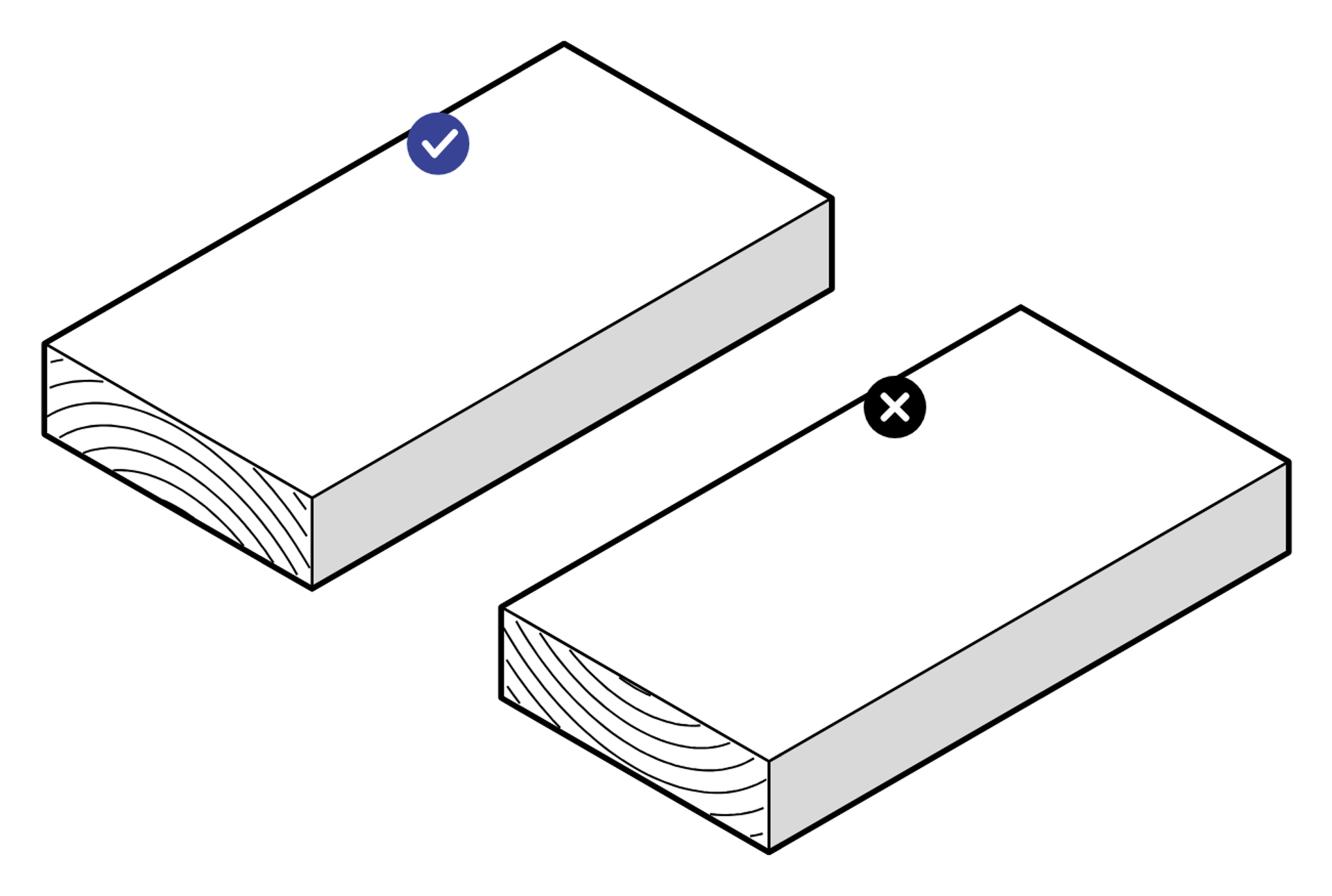
Choose the visible face. Install the boards with the better side facing up. Also aim to keep the heart side as far from the visible surface as possible. This reduces cracking.
Sort the boards. Arrange the boards so that the knots are spread evenly across the whole deck.
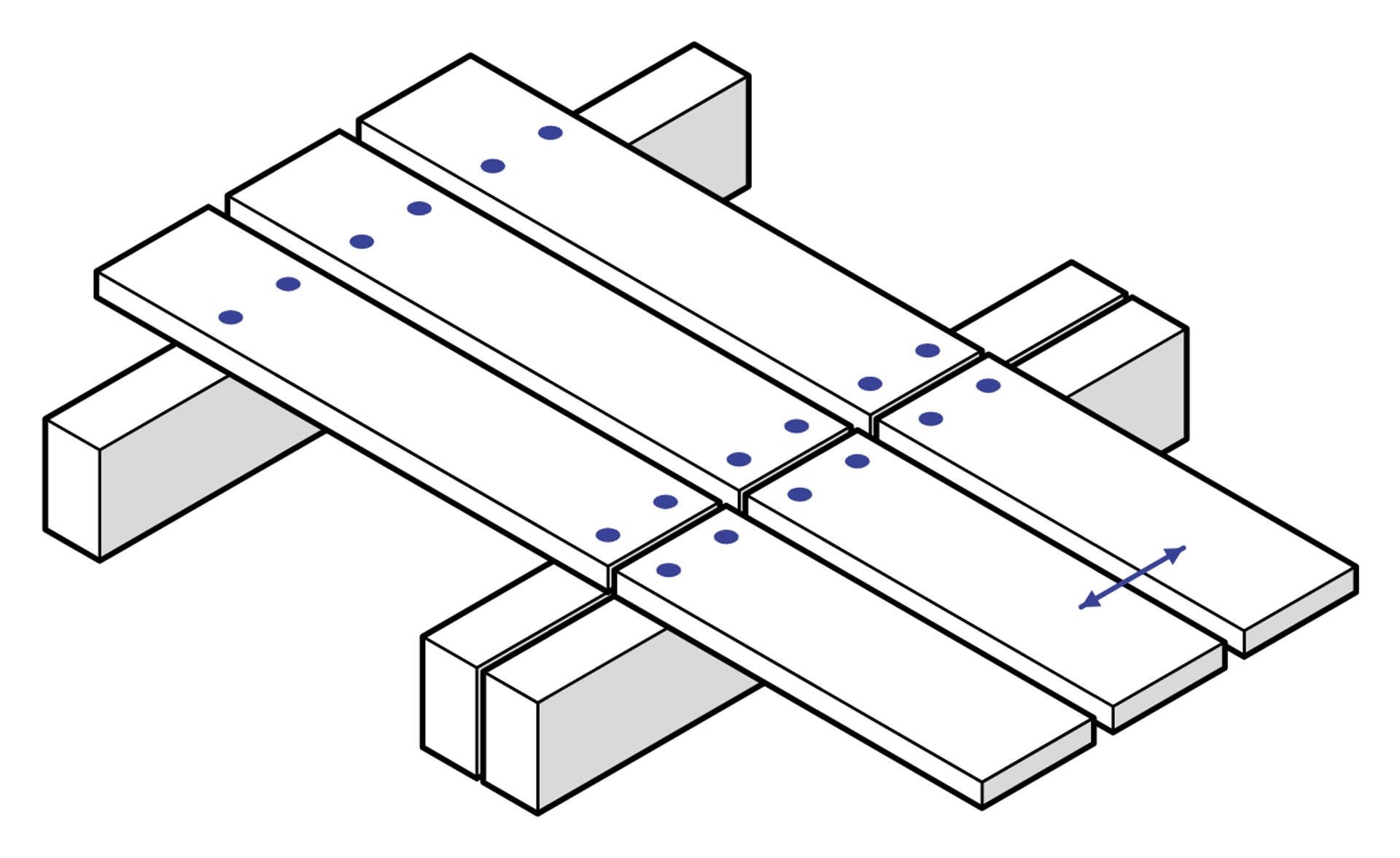
Leave a wide enough gap. Boards stored out of the weather swell once they get wet after installation. That's why you need a wide enough gap between the boards.
- Uncovered deck or pier: at least 8 mm
- Covered deck: 5 mm
These gaps are guidelines for a 145 mm wide board. If you use a wider board, increase the gap. Spacers help you keep the gaps even.
Check the alignment. Measure at regular intervals to make sure the boards stay on the planned line.
Fastening
- Use the right screws. Fasten the boards with countersunk A2 stainless steel screws. By the sea or near a swimming pool, use acid-resistant A4 stainless steel screws.
- Choose the screw size according to the board thickness.
- 28 mm board: 5 x 70 mm
- 45 mm board: 6 x 120 mm
- Fasten each board with two screws at every joist.
- Keep the right distances. Place the screws at least 20 mm from the edge of the board and at least 50 mm from the end of the board.
- Pre-drill the screw holes, especially at the ends of the boards. This keeps the boards from cracking.
- Drive the screws to the right depth. The screw head should sit flush with the board surface or no more than 2 mm below it. A protruding head can be a tripping hazard, and water collects in a hole that is too deep.
Finishing
- Leave a gap of at least 20 mm between the deck and other structures so that air can circulate and rainwater can drain away.
- If you clad the sides of the deck, leave at least half of each side open for ventilation.
- Spread gravel around the deck. It keeps plants away, improves ventilation and makes maintenance easier.
Good to know
Boards containing heartwood may develop cracks over time. Cracking can't be avoided completely, as it is a natural characteristic of all wood species. The cracks do not affect the durability of the deck.
 Surface treatment
Our decking boards don't need any surface treatment. The wood is naturally rot-resistant and dense, so it withstands Finnish weather conditions without oil or paint. That's why we don't recommend any surface treatment at all.
Turning gray
An untreated deck turns a beautiful silvery gray from rain and the sun's UV radiation. Depending on conditions, this takes about 2–3 years.
In covered and other sheltered spots, the wood turns gray more slowly. The same applies to areas under furniture, planters or rugs. This is why the surface may look patchy at first. The difference evens out over time, and you can speed this up by moving planters and rugs around during the first few years.
If you want to influence the color
- Slowing down the graying: You can slow down the graying by treating the deck with a clear or tinted deck oil. Oil soaks into dense wood slowly, and the treatment must be repeated much more often than on spruce. Without repeated treatments, the natural graying of the wood can't be prevented.
- Speeding up the graying: Iron sulfate (green vitriol) makes the deck turn gray quickly and evenly. Brush or spray a mixture of iron sulfate and water in a ratio of 1:10 onto the surface twice. The graying starts once the surface is exposed to daylight, and the final color develops in about 7–14 days.
 Maintenance
An untreated deck is almost maintenance-free. When you keep it clean and the structures in good condition, your deck lasts for decades.
Check your deck once a year
- Make sure all the screws are in place, and tighten or replace any loose ones.
- Clear leaves and debris from the gaps between the boards so that water can drain away.
- Make sure air can circulate under the deck and that no debris or plants build up there.
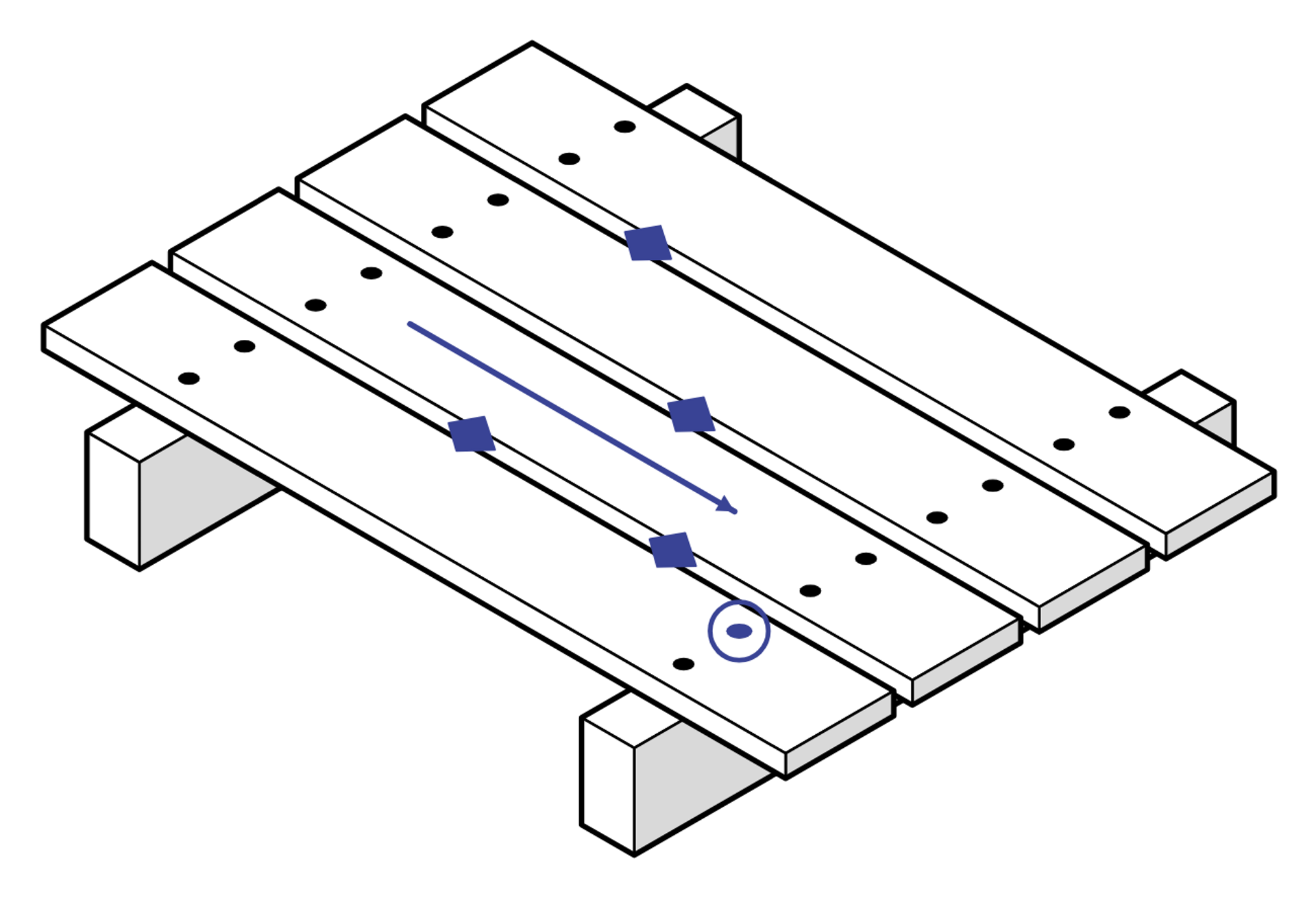
Splintering
Especially on uncovered decks and piers, some boards may start to splinter after about a year. This is natural for wood, and the splinters are easy to remove:
- sand the surface along the board with 180-grit sandpaper, or
- scrape the surface with a cabinet scraper.
Good to know
- Small cracks: Over time, sunlight and changes in moisture and temperature may cause small cracks in the wood surface. This is a natural characteristic of wood and does not affect the durability of the deck.
- Dark marks around fasteners: Douglas fir and larch are rich in natural extractives, which can react with galvanized fasteners and leave dark streaks around them. As the wood turns gray, these streaks become hard to notice. That's why we recommend stainless steel screws for fastening the deck.
Thorough cleaning
Give your deck a thorough clean once or twice a year.
- Choose a cool moment. If you use a cleaning product, wash the deck when it's not in direct sunlight. This keeps the cleaning product from drying on the surface too quickly.
- Brush off dust and debris with a long-handled brush. Brush the edges of the deck and other structures too.
- Wet the surface with warm water. Warm water opens the pores of the wood.
- Wash with water and an all-purpose cleaner, using a soft brush, such as a scrub brush, or a scouring sponge. Brush along the grain of the wood.
- Rinse with cold water. Cold water closes the pores of the wood.
- Let the deck dry thoroughly.
Avoid cleaning products that contain chlorine. Chlorine can soak into the wood and be released into the air when the deck heats up in the sun.
If your deck is oiled
If you have oiled your deck for its looks, oil it after cleaning, once the wood is completely dry.
Choose the right weather
- Oil on a dry, overcast day after a few days that have dried out the wood. The moisture content of the wood must be below 20%.
- Avoid direct sunlight. On a surface that is too hot, the oil doesn't have time to soak in evenly.
- Start only once the morning dew has dried, and stop well before the evening dew settles.
- Don't oil if rain is forecast.
- Check the right application temperature in the oil manufacturer's instructions.
How to oil
- Apply a thin layer of oil with a brush or deck oil pad so that all the oil soaks into the wood.
- Work evenly, one board at a time from end to end. This keeps lap marks from forming.
- Wipe off any oil that hasn't soaked in.
- Let it dry thoroughly.
Lauta.fi delivers product sample pieces to both consumer customers and professionals, such as architects, interior architects and designers, construction industry and procurement professionals.
If you are interested in ordering one or more sample pieces, please contact our sales department via email lauta@lauta.fi or phone +358 3 3123 6000 (On weekdays 8-16).